

Permaculture has been mentioned regularly on this site and others as a sustainable way to live on the earth, a way in which to limit our environmental impact whilst using the earth’s resources. It is noticeable, however, how large a breadth of alternative visions are held by those practicing or praising Permaculture .
This and similar sites promote Permaculture in the context of Dismantling Civilisation, whilst most use it as a way of making Civilisation more sustainable. We believe that Permaculture is at its most useful and beneficial applied to Rewilding, rather than limiting it to reforming Civilisation.
A short definition of Permaculture is that it is a system of designing with the intent of replicating the cyclical systems of nature .
This began with just food production ( Permaculture derives from Permanent Agriculture), but it was soon realised it could be applied to all areas of life to make them sustainable.
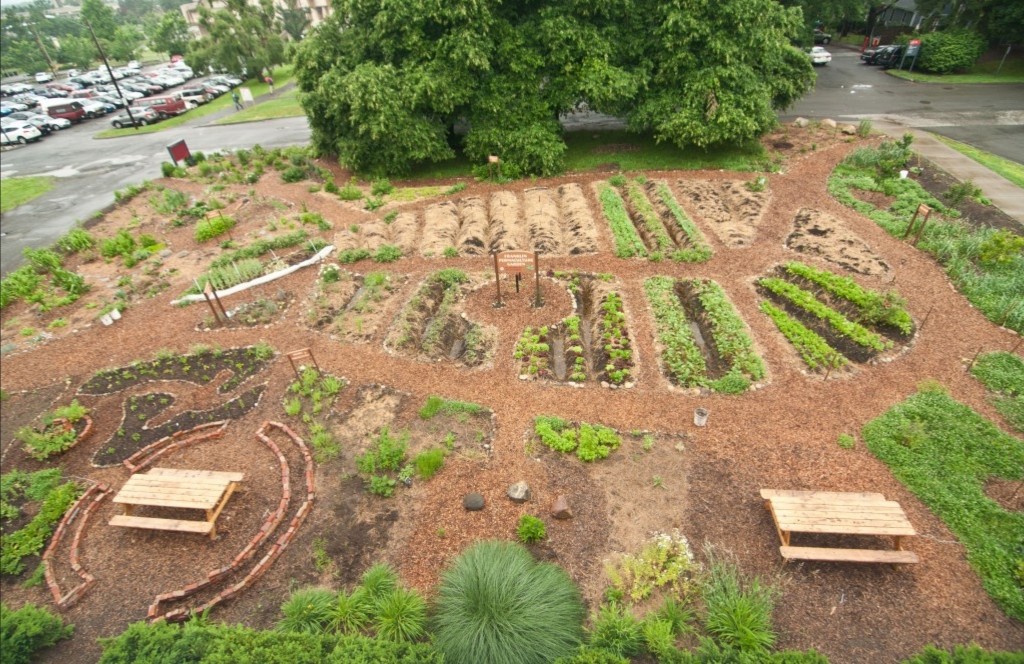
A Permaculture garden can often be described as an ‘ edible ecosystem ’, with plants beneficial to humans placed in relation to each other and other influences and factors so that every output is another’s input – there is no waste . It is based on the realisation that nature does, and has done for 4.6 billion years, a much better job than us of creating complex systems with high biomass and diversity that satisfies all the lifeforms involved.
Monocultural agriculture has failed to create anything near as complex, and requires huge inputs compared to a self-sustaining forest. As a result of these concepts, Permaculture is very much an inclusive approach , seeing humans as part of the global ecosystem, and not separate as in the myths of Civilisation .
Permaculture is only a tool to assist on the path of the greater struggle to rewild.
A growing movement of people have taken up Permaculture as a great way forward, seeing it as the best path to sustainability . This can be seen in the Transition movement, in which people are preparing for Peak Oil and Climate Chaos by collectively reducing their town or village or cities energy requirements. However, most of these people see it as a way of making the current state of affairs more sustainable – they are reforming Civilisation with it rather than dismantling it.
When talking about ‘doomers’ i.e. those who believe we are on the brink of collapse, I have heard remarks questioning their sanity and motives, seeing them as extreme and unhelpful in the debate. Even in these circles, questioning Civilisation can be a risky business .
These movements are at the forefront of the environmental movement, and show some of the best reactions yet to the global crisis. But how much difference can they make if limited to reforming civilisation?
Permaculture is based around principles including cyclical systems with no waste, equality of parts, inclusivity of humans and fair shares.
Civilisation , in contrast, is based upon the principles of linear, non-cyclical systems (input-process-output) creating waste and resource depletion, inequality of parts through hierarchy, humans as being separate to the earth and thus able to abuse it, and unequal shares of natural resour ces.
The two are complete opposites!
If we were to fully implement Permaculture to its full extent, Civilisation would have to be dismantled and replaced. Just partially implementing it to counter the negative consequences of Civilisation is not enough to stop the rape of the earth.
It is not the reformist fault that they stop short of attacking Civilisation – it is all they have ever known and are unlikely to have considered its structure and impact on the planet.
Their action through community gardening, smallholdings and Transition Initiatives is an inspiring first step in tackling the world’s problems.
But we have to take the next steps beyond this quickly in the short time we have, and to do that Permaculture has to be seen as a tool for many further means. Permaculture is an immensely useful tool for repairing our relationship with the earth and its inhabitants, but in order for its full potential to be realised we must use it for rewilding, not just reforming .